Simena: a new take on a classic look by Ares Yachts
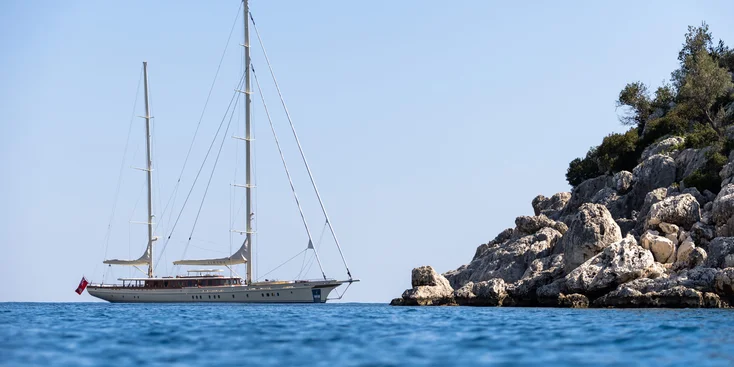
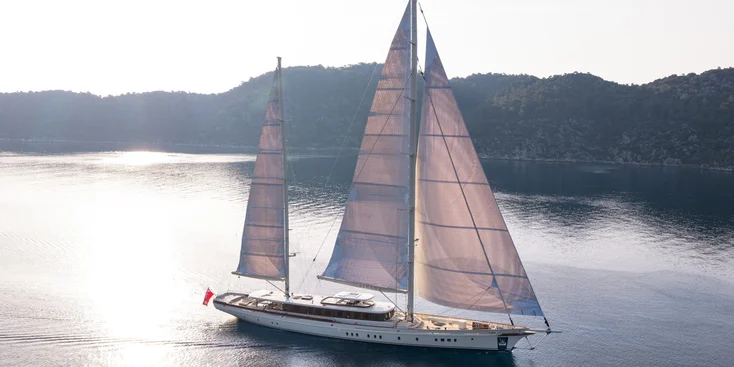
About 150 km from Antalya, Turkey, there is a sunken city. Today, the place is called Kekova, but it used to be called Simena. The settlement that existed as early as in the 4th century BC was almost completely submerged after an earthquake. The streets and walls of the houses are still visible through the clear water, and the village that appeared in its place later can be accessed only by boat
Turkish Ares Yachts has named its debut sailing superyacht Simena after the local legend. For twenty years, the Kalafatoğlu family has been building high-speed patrol boats for or the coast guards of Bahrain, Oman, Qatar and Turkey – over 230 vessels for over 15 countries. In 2023, the yard announced it was entering a new segment and presented the new brand at the Monaco Yacht Show.
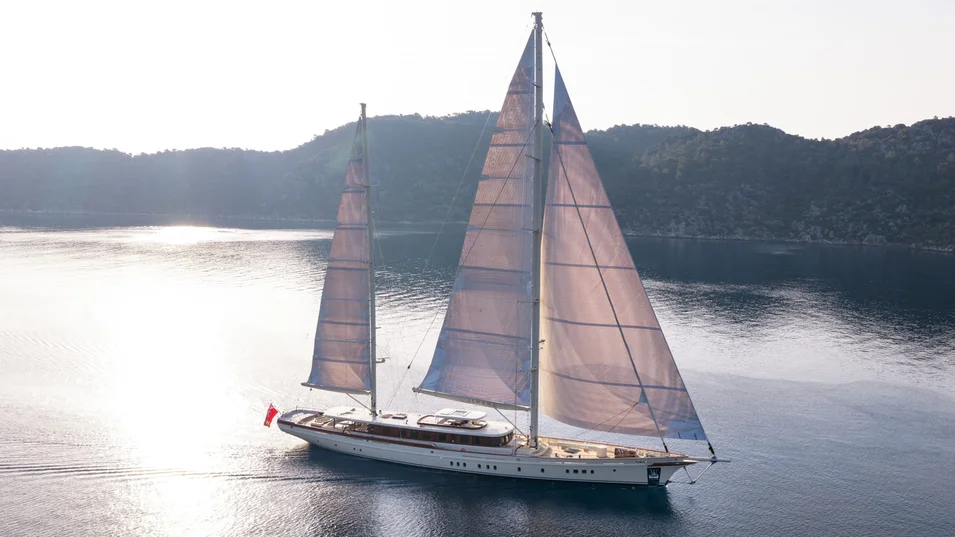
For the Kalafatoğlu family, the Simena has become far more than the first yacht. The 62-metre ketch with a steel hull and GRP superstructure was built on spec and made her world premiere at the Palma Superyacht Show. The sailboat’s unique exterior is impressive, despite her resemblance to such boats as the Kokomo and the Imagine by Alloy, the Andromeda la Dea by Perini Navi and the Ravenger by Royal Huisman.
The yard claims that the Simena is the largest sailing yacht ever designed and built in Turkey. And upon closer examination, this statement appears to be true. The 64.5-metre Mikhail S. Vorontsov (now Red Sky) was launched in 2013, and she is longer. But her hull was built in Turkey at Dream Ship Victory and then transported to the Netherlands, where Balk Shipyard completed her outfitting. Her naval architecture was developed by Dutch Dykstra Naval Architects. The Simena is a different case: the project, construction and outfitting were all done in Antalya. And what about the Regina launched in 2011 by Turkish Pruva Yachting that starred in the Bond movie a year later? She is just 56 metres.
Outside
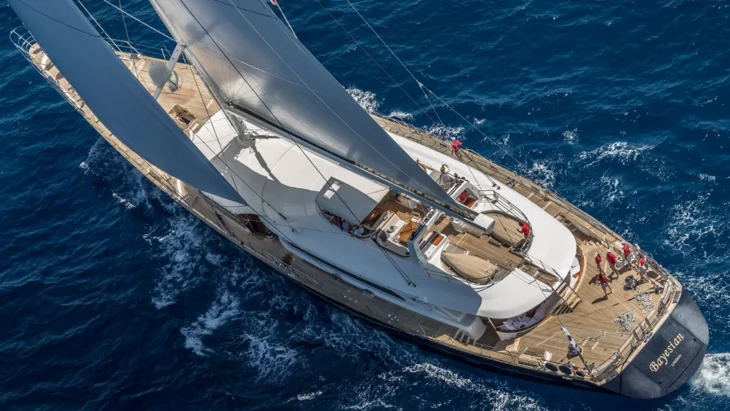
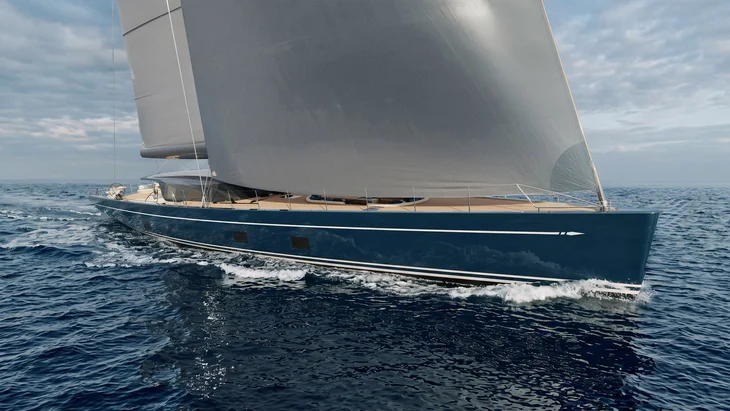
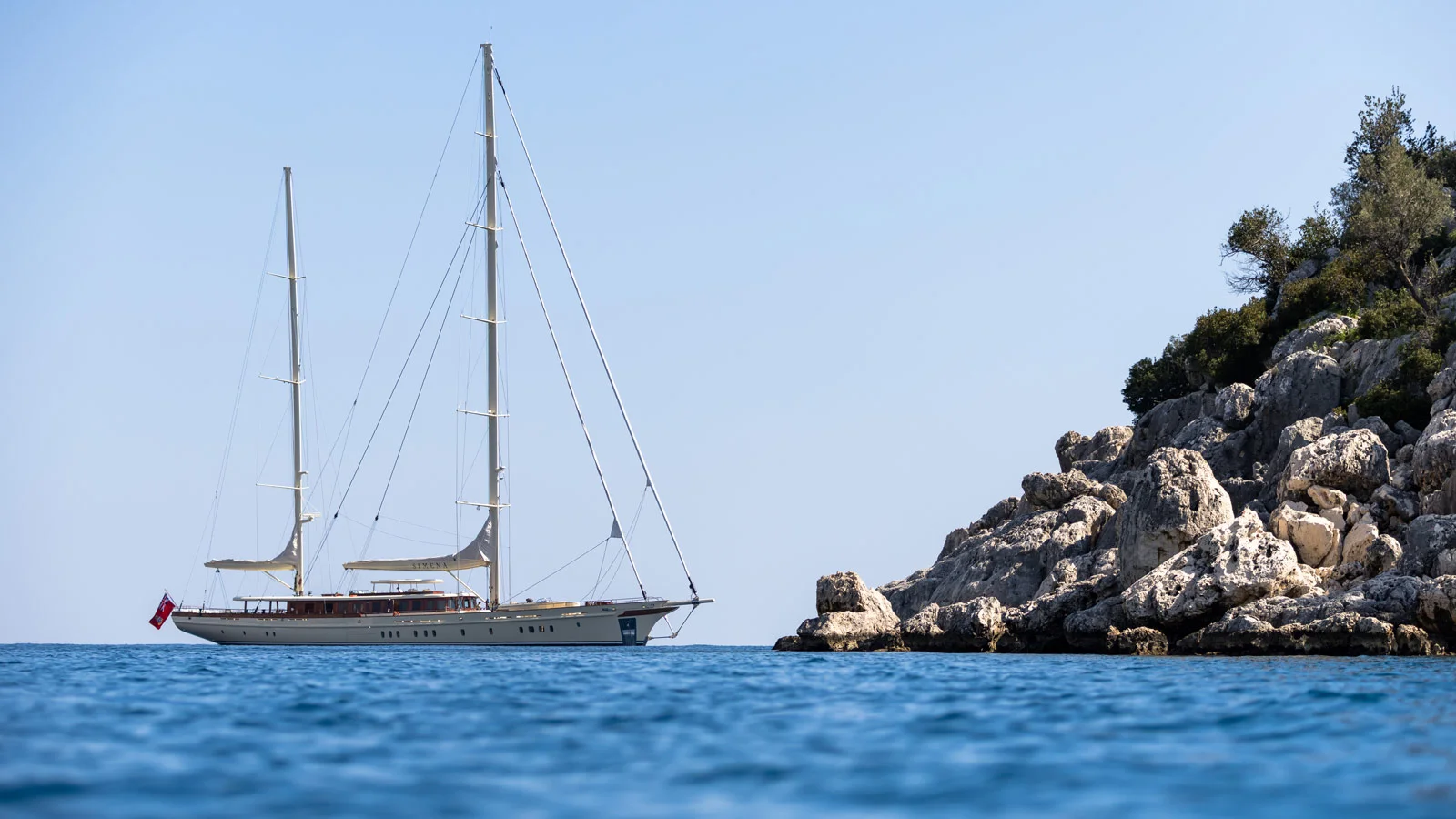
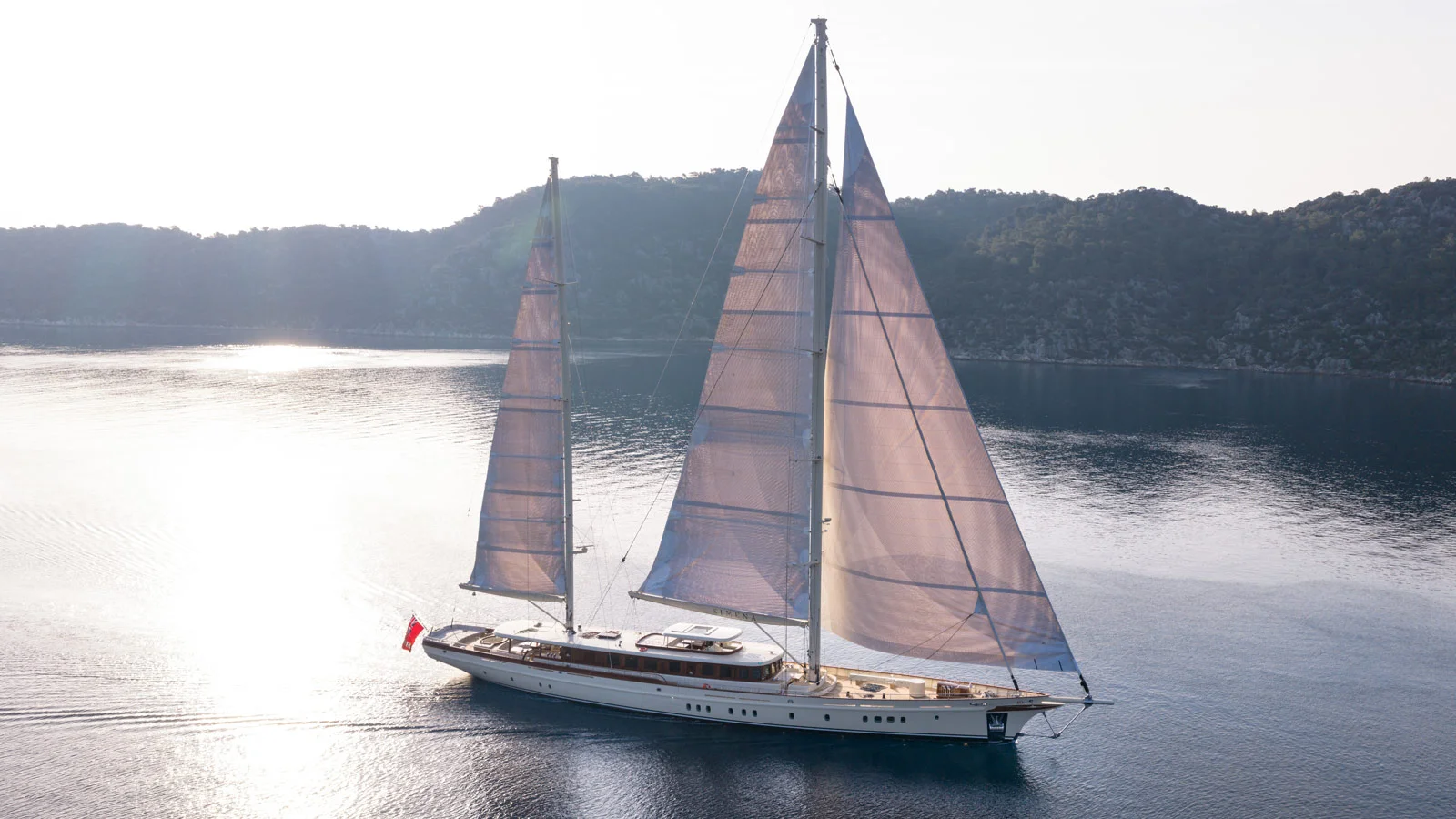
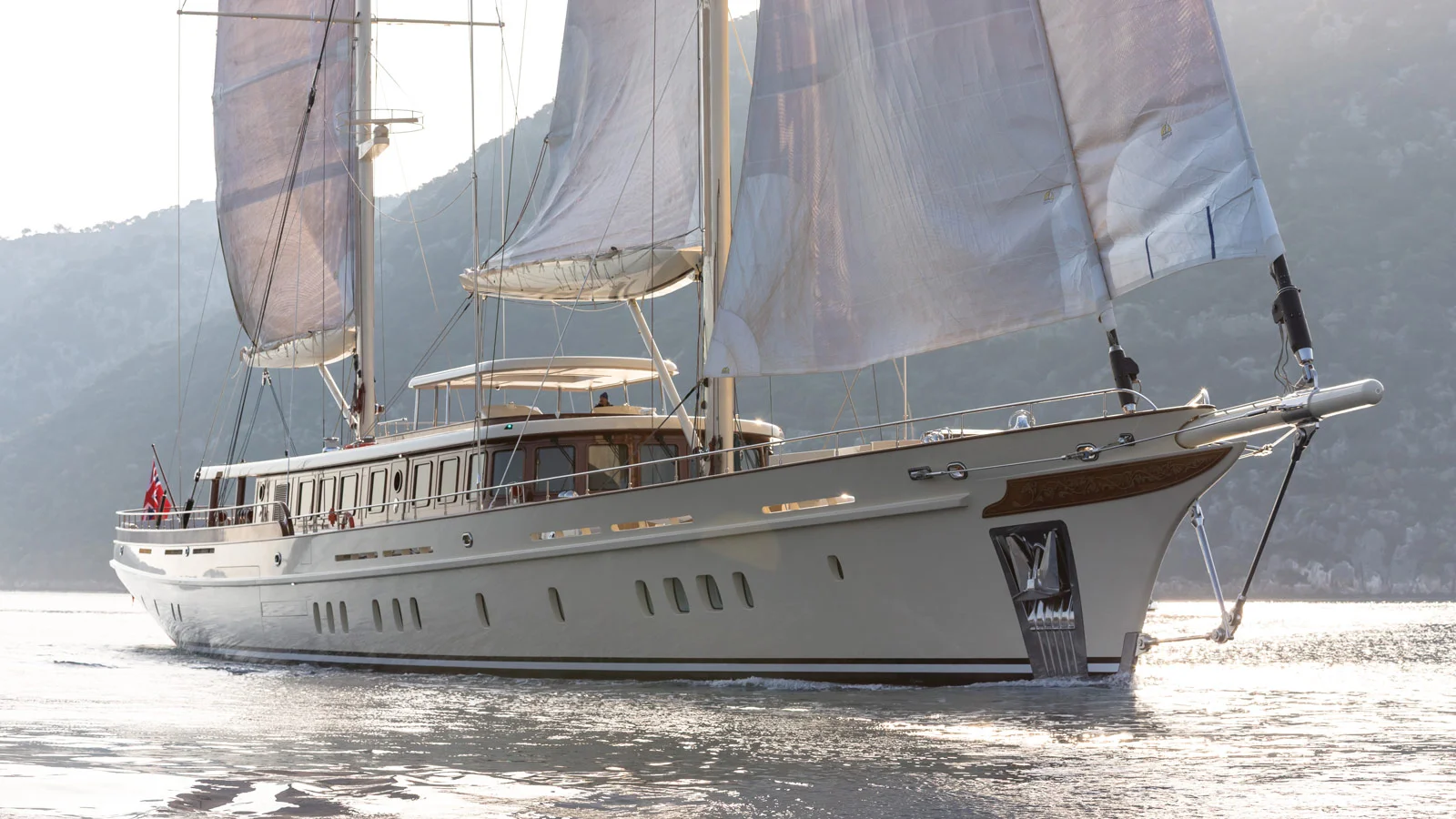
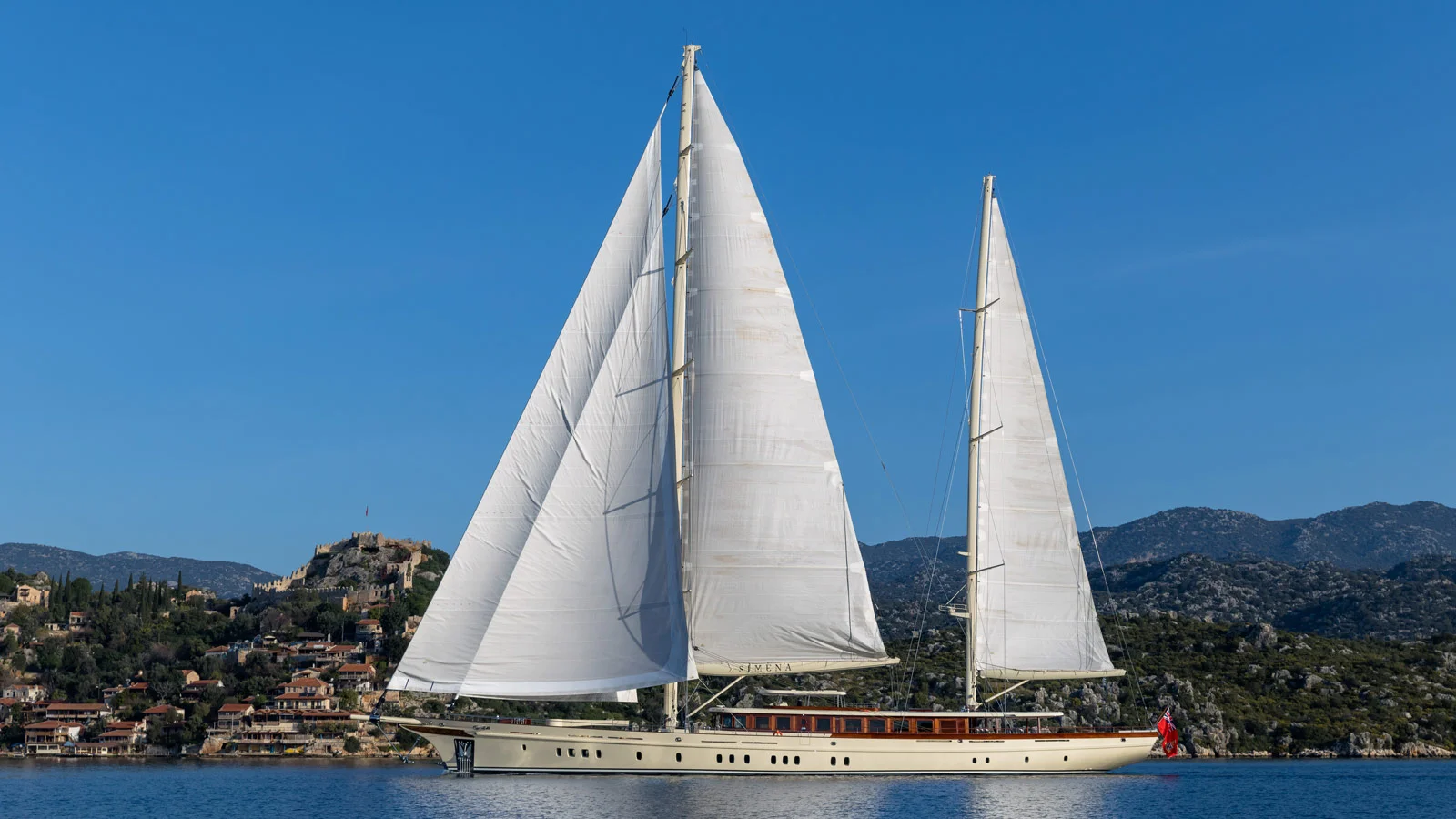
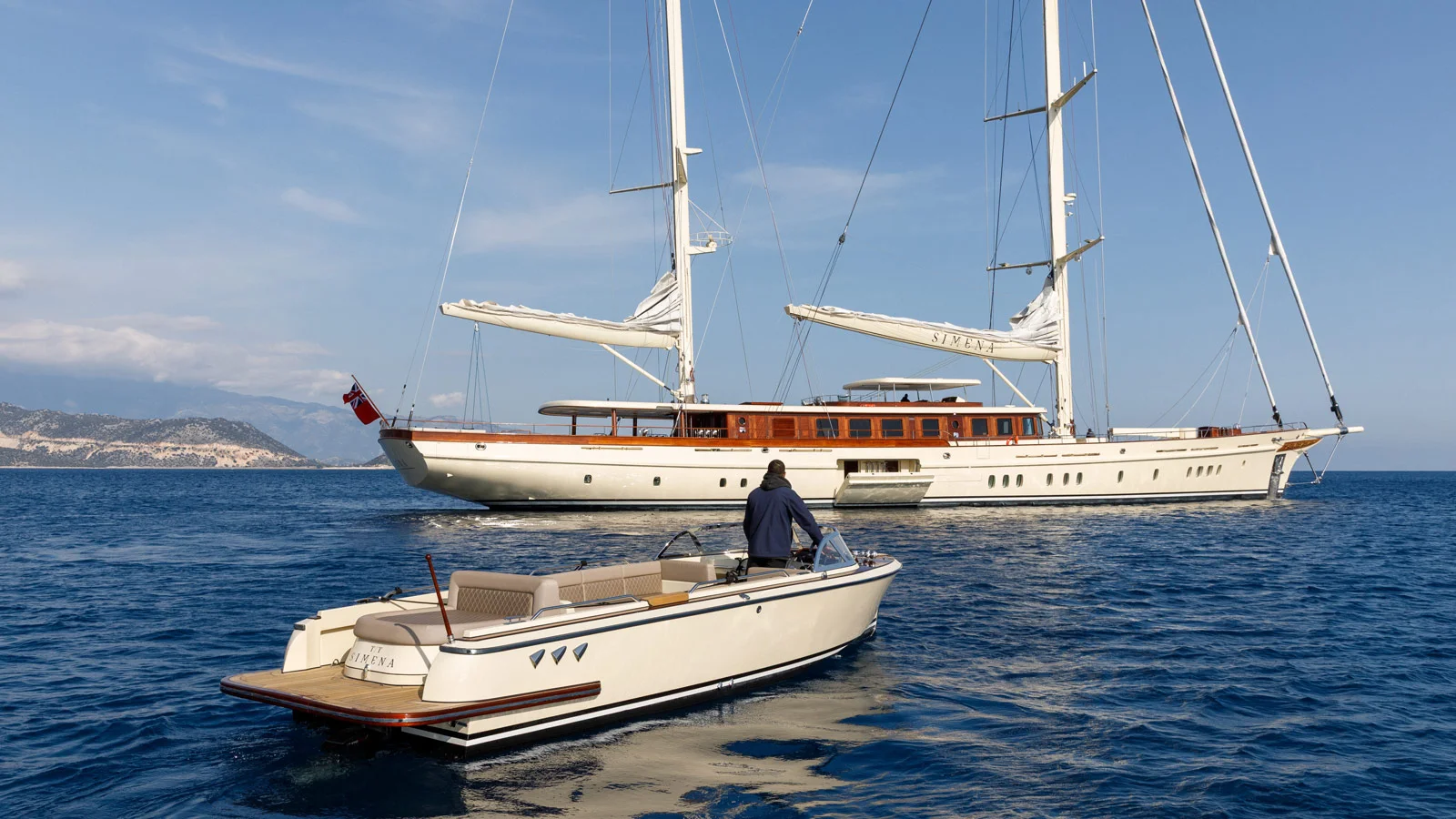
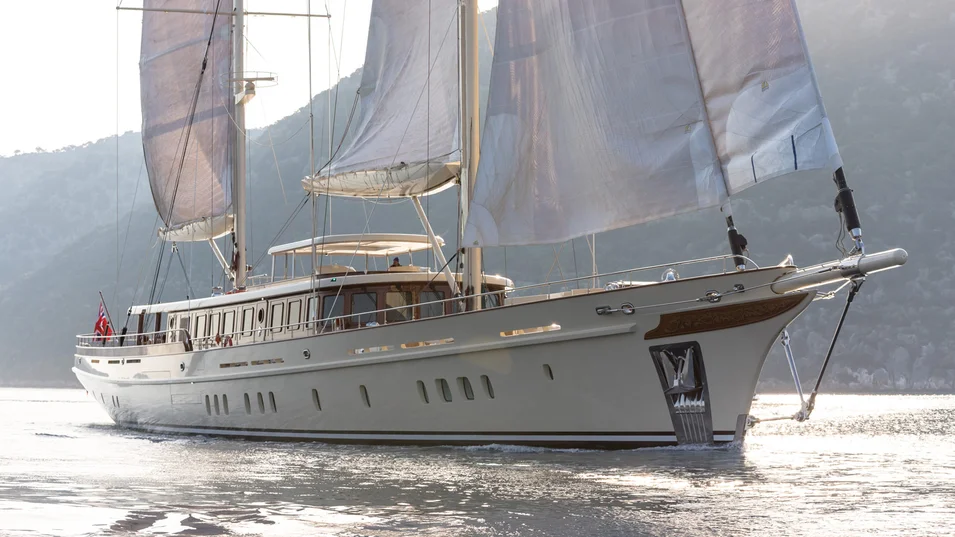
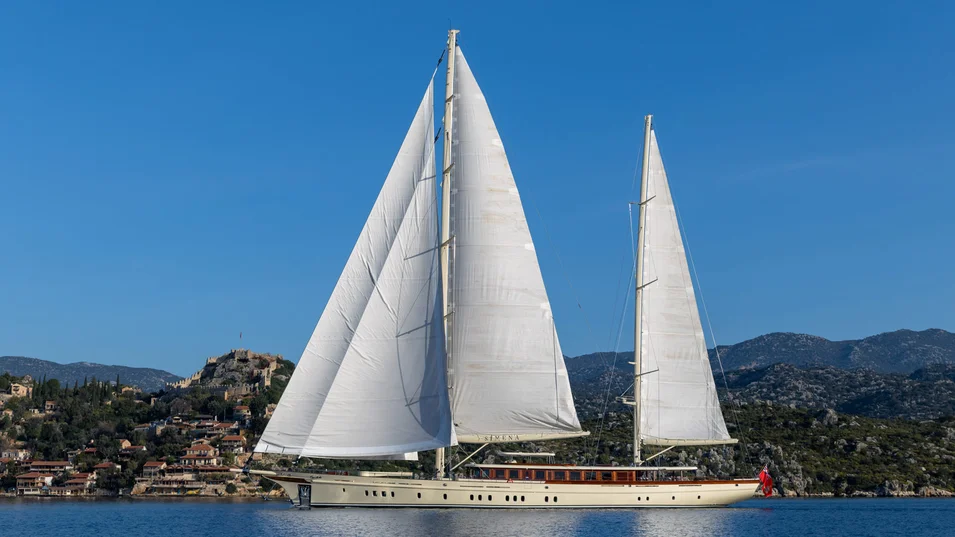
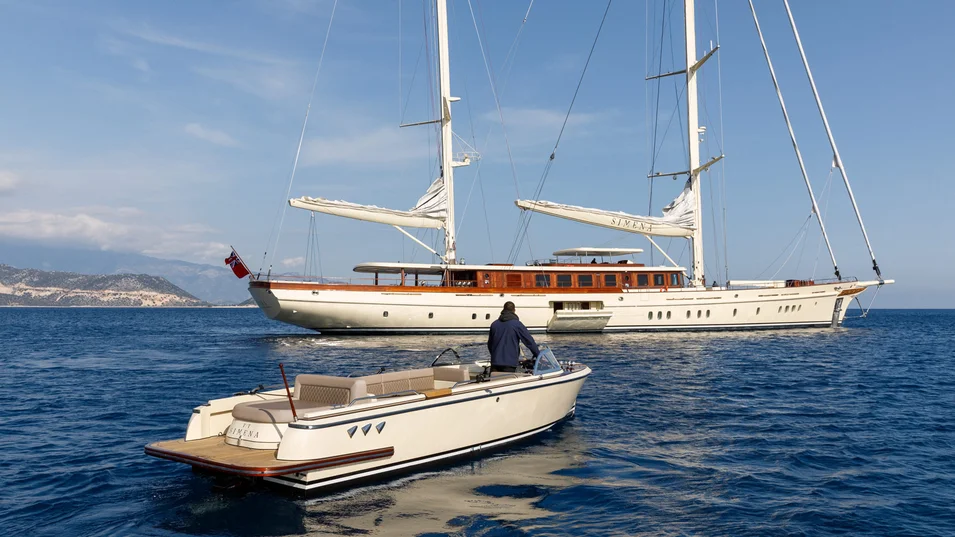
With her clipper bow and modest overhangs, the Simena looks like a gentleman’s boat from the 1920s. The aft section is traditional and is a direct reference to the sailing boats of the past. The hull looks snow-white in some pictures, but in fact it is painted a vintage shade of ivory with a dark-red waterline. The masts are the same ivory shade, too. From the top and three quarters from the stern, the Simena can be easily taken for a carefully restored classic boat.
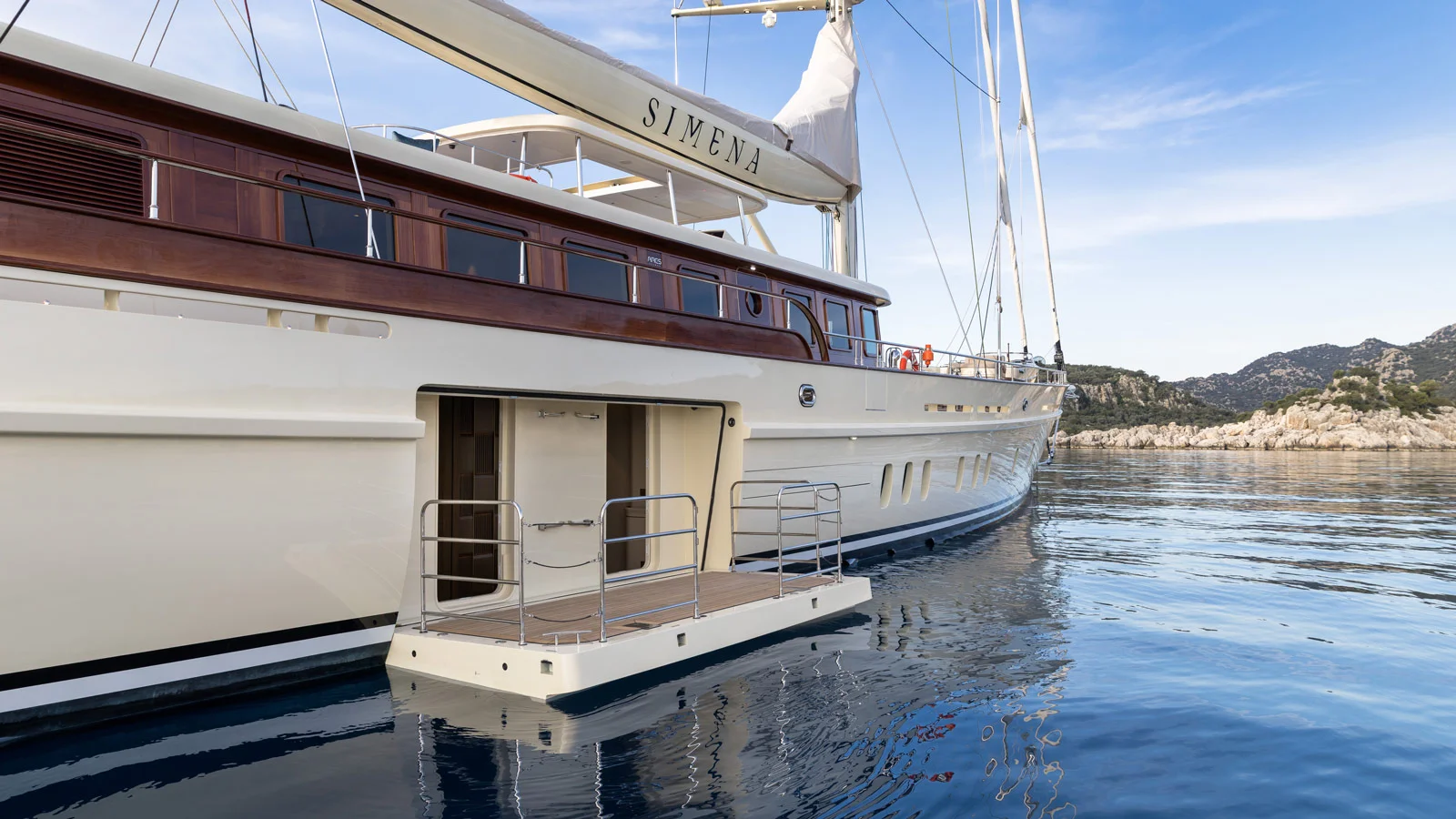
But when you look at the starboard side, the picture gets more complicated. The fold-down platform amidships through which guests come aboard is a modern feature that was not available on sailboats of the last century.
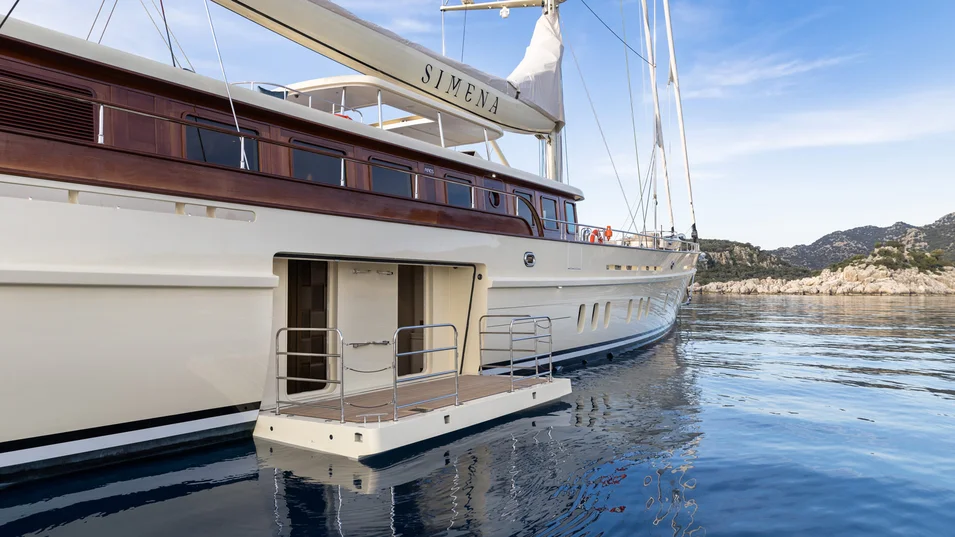
The low elongated superstructure with a broad band of glazing resembles Dutch sailboats, although those are more often shorter and segmented. Much like the classic Turkish gulets, too, that might have inspired the designers at Taka Yacht Design, as they are frequently commissioned to create precisely this kind of yachts that evoke the past while incorporating modern features.
The most unusual feature of this superstructure is the flybridge. A separate, elevated wheelhouse with a hardtop above the forward section of the superstructure is a feature more reminiscent of early 20th-century steamships than of a traditional sailing yacht. For the sailboats the size of the Simena, flybridges are normally moved amidships or towards the stern, while bringing them forward is more typical of larger vessels like the 90-metre Athena, which is justified by her scale.
Delivering one of the world’s largest ketch-rigged sailing yachts as a first project in this segment is a strong demonstration of capability. More importantly, the project establishes a new benchmark for what can be achieved in Türkiye in the large custom sailing yacht category, both in engineering and execution.
Tanju Kalaycioglu, Taka Yacht Design founder
Only Perini Navi consistently incorporates flybridges on modern sailing yachts, and it was first to add a full-fledged upper helm station to large ketches and sloops. The closest in size is probably the 60-metre Katana built in 2025 to Ron Holland’s design. But that is where the resemblance ends.
With her aluminum hull, carbon rig and lifting keel, the Katana was built for those who venture into shallow bays and take part in informal regattas. The Simena opts for a different way: fixed keel, steel hull, 4.72 m draft, 570-ton displacement. She’s not about speed, maneuverability and racing, but about range and comfort. She was designed for long passages, leisurely cruising and extended stays at anchor.
Railings of polished stainless steel and wood, featuring an elegant, distinctive curve, run along the sides. Their height and rhythm complement rather than disrupt the horizontal lines of the superstructure.
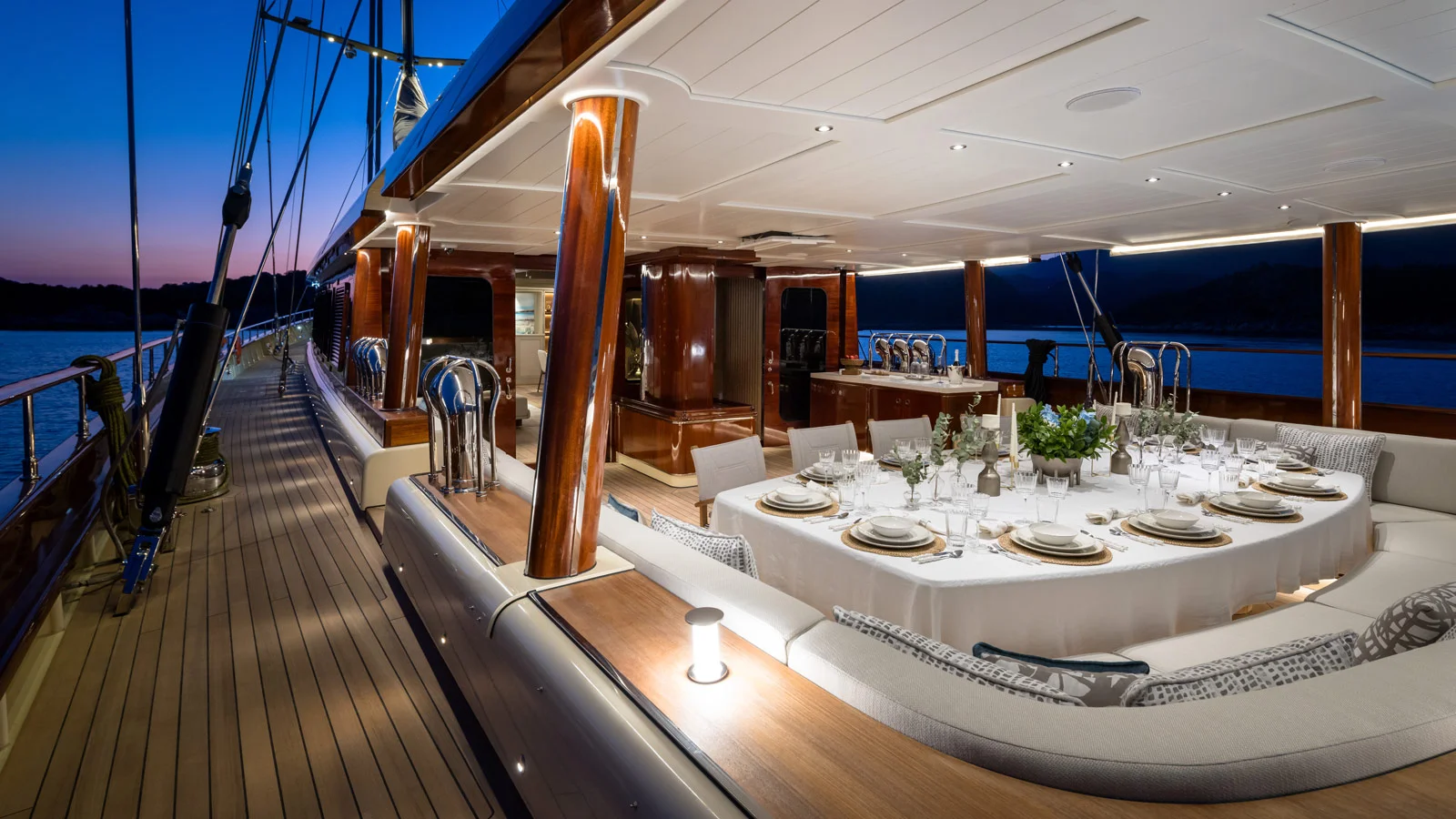
There are rows of polished dorade boxes along the side decks. These classic yacht ventilators catch the wind and channel fresh air into the cabins below deck, while keeping both spray and rain out. They have long since become a thing of the past on modern yachts equipped with air conditioning. On board the Simena, however, they gleam in the sun, and are another reminder that it was important to the creators to emphasize the classic element of the vessel.
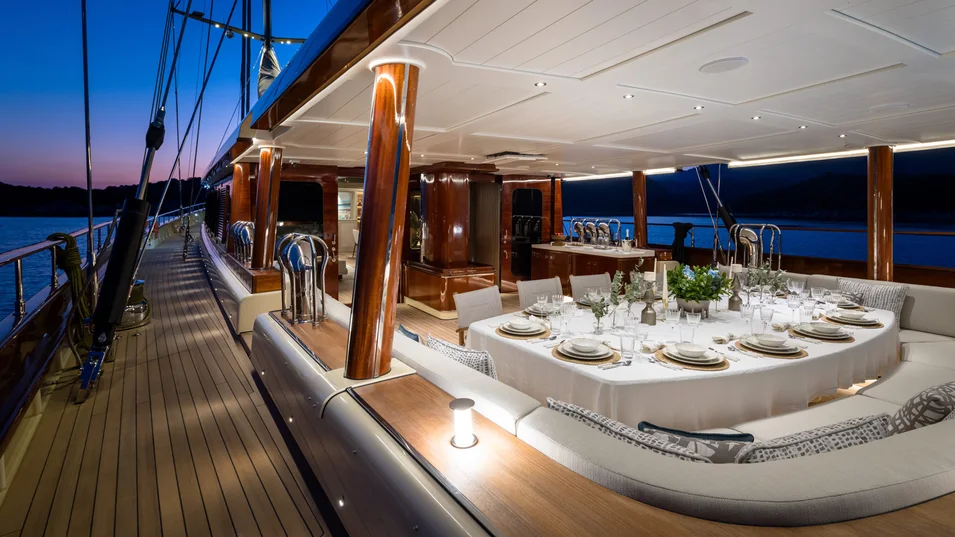
The decks are laid with narrow teak planks featuring dark caulking – quite distinct from the broad, relaxed decking typical of modern Mediterranean charter vessels. The Sipo wood on the superstructure is finished with multiple coats of varnish and polished to a mirror-like sheen. It is this wood, combined with the softly contoured windows, defines the classic narrative of the Simena’s exterior design.
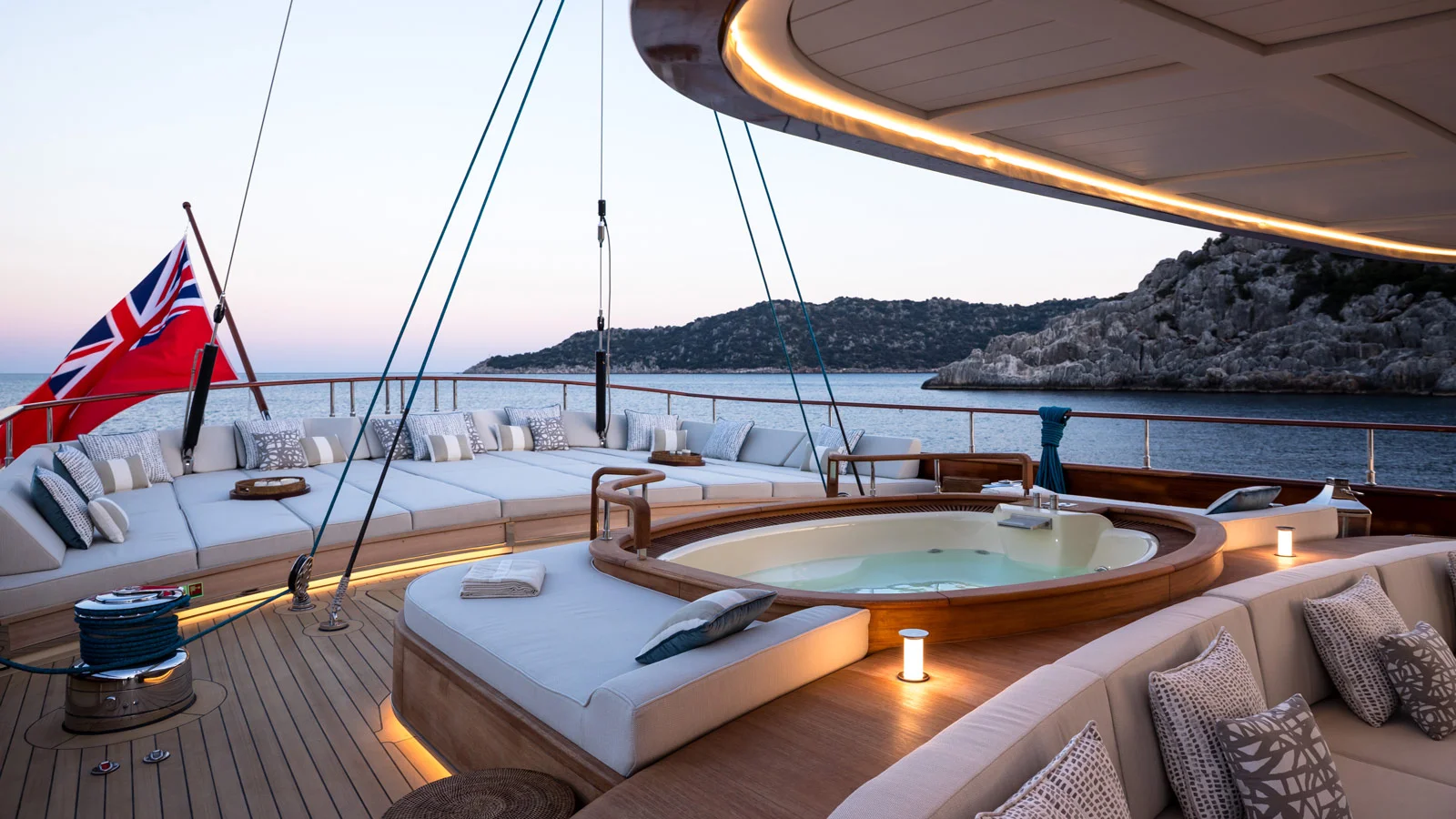
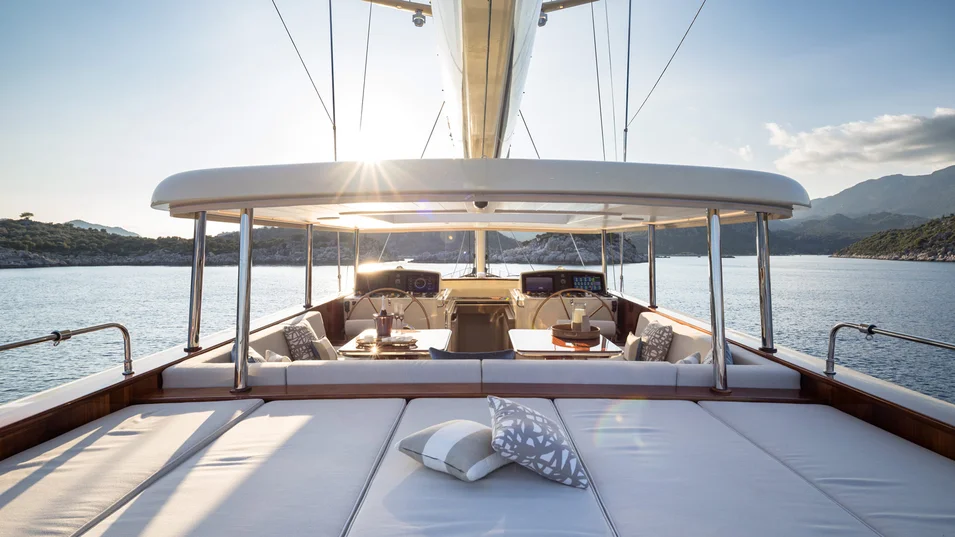
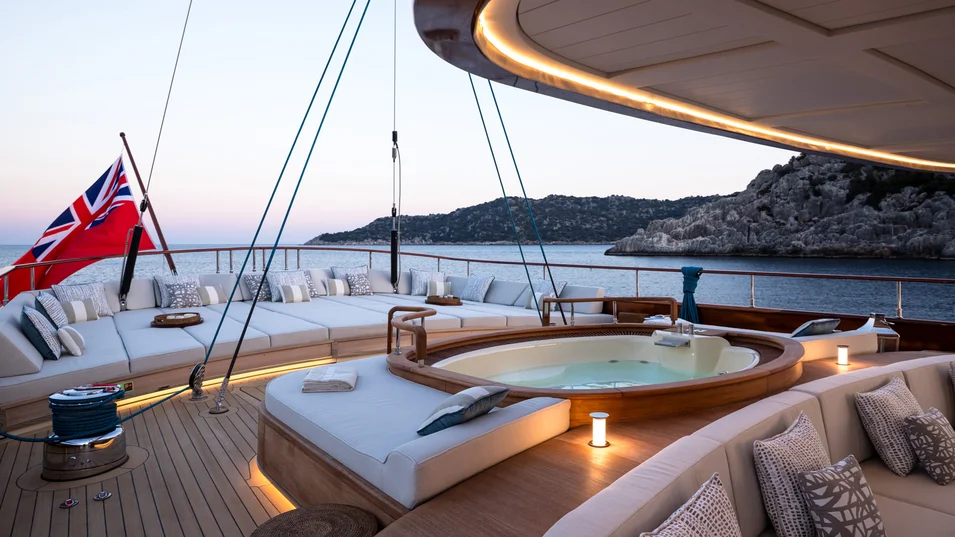
While you normally look for helm stations and slender steering wheels on the sterns of other sailing yachts, you won’t find them on the Simena. Instead, there are sunpads and a jacuzzi. It is a signature feature of yachts with Turkish roots: no luxury vessel is complete without a beautiful "water feature" on the aft deck, and the Simena is no exception.
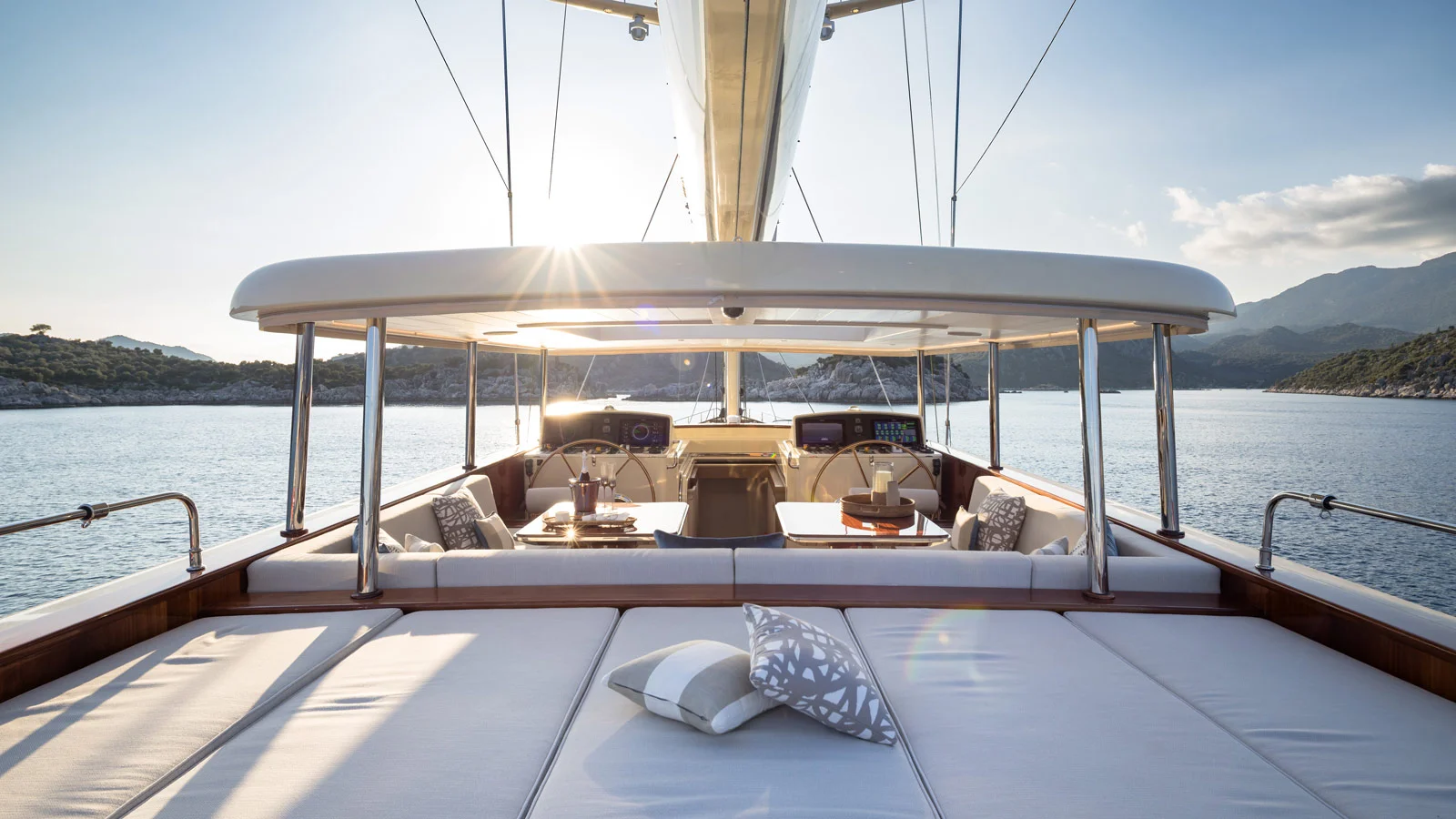
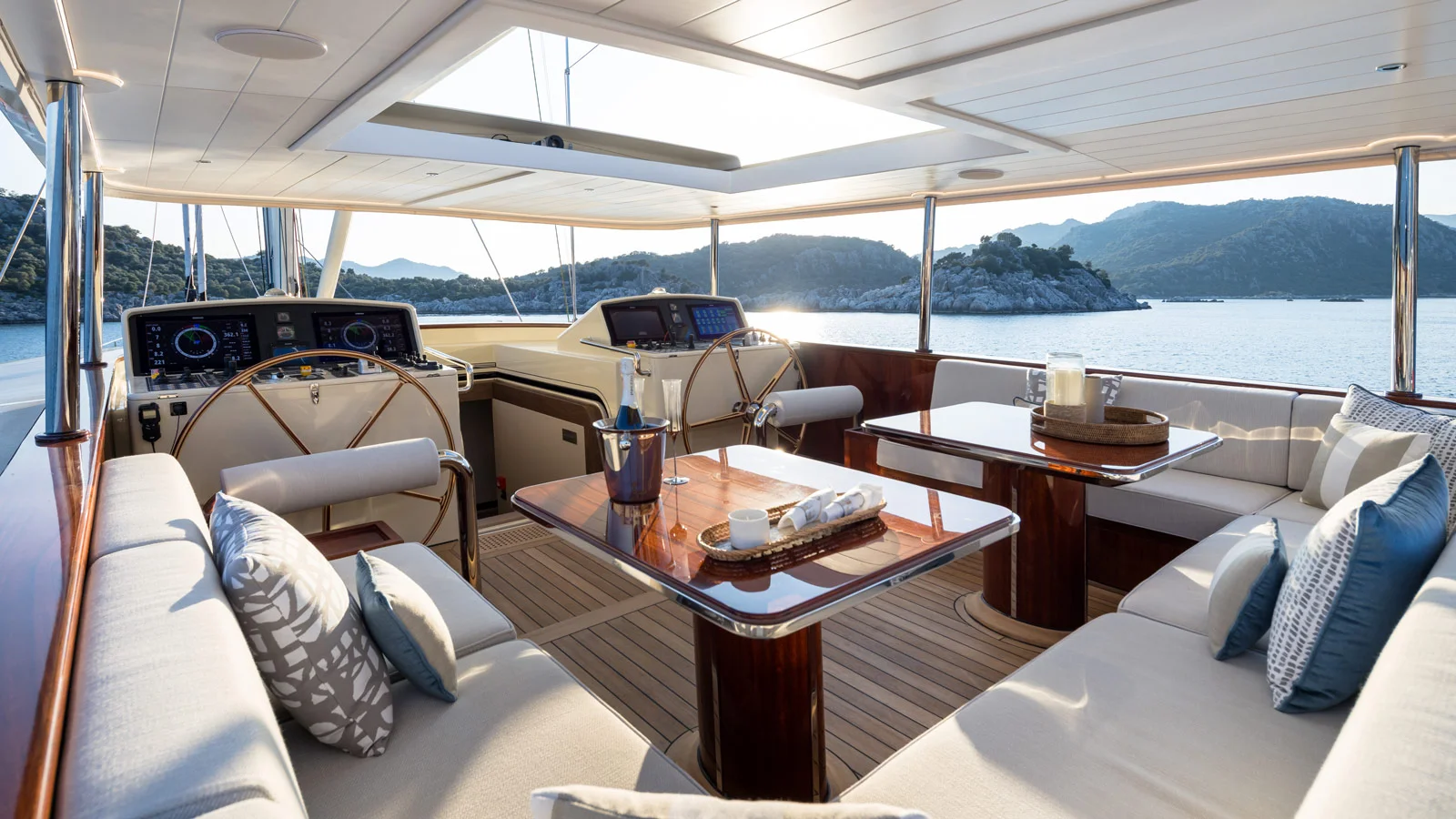
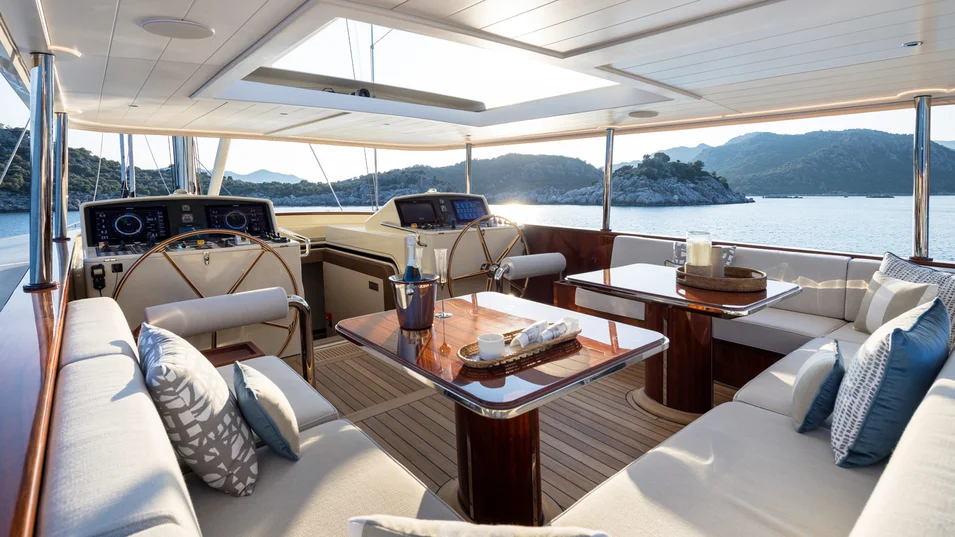
The cockpit is well protected with a high, reliable hardtop. It features large sofas and two polished tables spaced so that guests can have two separate conversations simultaneously. Yet, it can be easily reconfigured for everyone to sit together: the tables can be combined to form a dining area for fourteen. There is also a bar with a grill here, too, concealed under the polished table tops.
While the cockpit area usually serves to bring guests and the helmsman together, there is no such need here. The captain handles the yacht from a magnificent bridge at the bow (where his cabin is also situated), while the guests relax at the stern. For those who wish to take the helm themselves, there is a flybridge featuring dual helm stations. However, it isn't possible to access it without the captain’s knowledge, as the only entry point is via the bridge. In addition to the steering wheels and navigation equipment, the flybridge offers a space for cosy breakfasts and morning sunbathing – a private, intimate retreat.
To get away from the crowd, one can also retreat to the foredeck, accessible via wide side decks. Here, by the mainmast, there is a large sofa and a comfortable table that create a more private, intimate atmosphere. The foredeck also serves a practical purpose of stowing two tenders: a custom limo by Ares Yachts for the guests and a large Northstar for the crew, which (together with a jet ski) can be launched and retrieved with the help of a two-ton crane painted the colour of the hull.
The sail plan by Doyle was designed by Chris Mitchell, who specialises in large cruising yachts, and his sails are optimised for a wide range of conditions encountered on long passages rather than for specific headings or wind angles. The mainmast is 59.5 meters tall, and the mizzenmast is 48.7 meters. The sail plan comprises a mainsail of 470 sq.m, a mizzen of 249 sq.m, a genoa of 597 sq.m and a staysail of 356 sq.m, totaling 1,671 sq.m. This is a substantial rig for a 570-ton ketch, yet the Simena does sail: during the sea trials, she reached a speed of 16 knots in 20-knot winds on a heading of 100°, which exceeded all expectations.
Inside
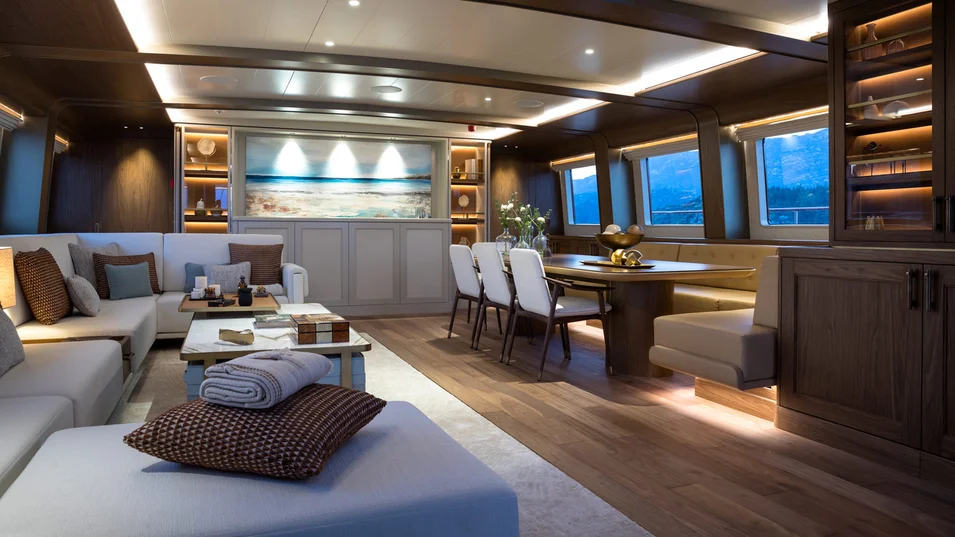
The Simena’s interior is owed to British Design Unlimited studio headed by John Everett, who has previously worked with Royal Huisman, Vitters and Pendennis. “We wanted to reinvent the wheel with a modern take on the classic look,” said Everett. Design Unlimited designed a whole range of fully custom furniture and tried using only Turkish materials. The interior details clearly demonstrate a love of vintage and the more you look, the more interesting it gets.
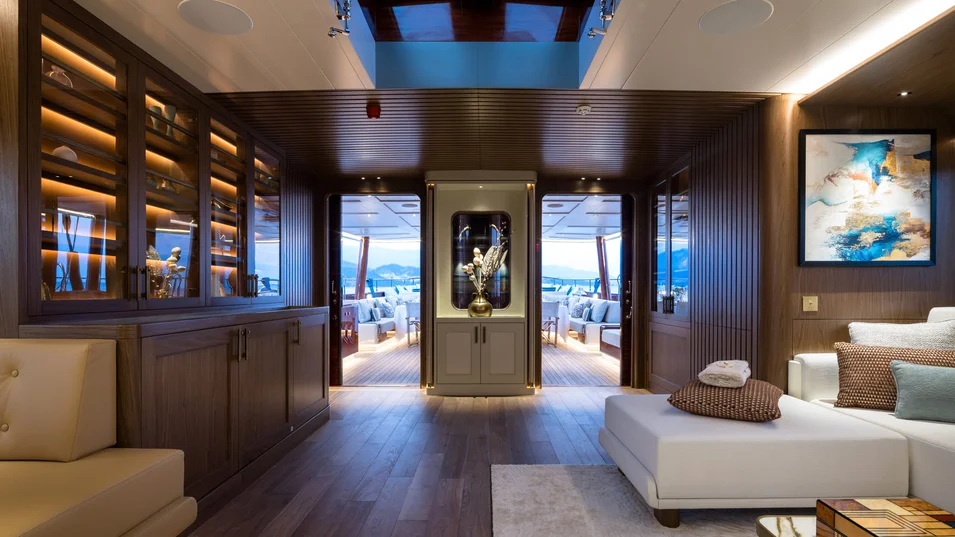
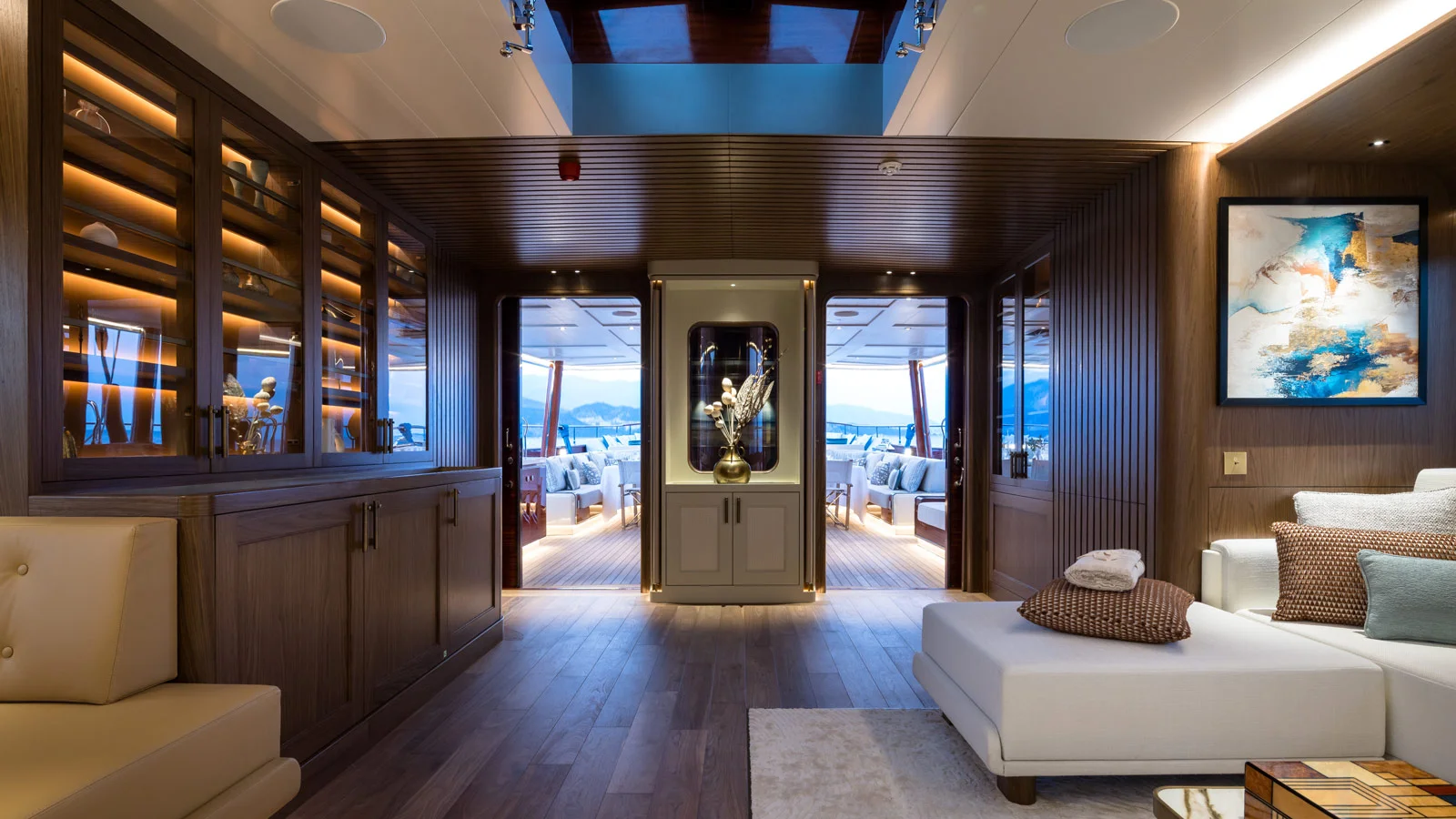
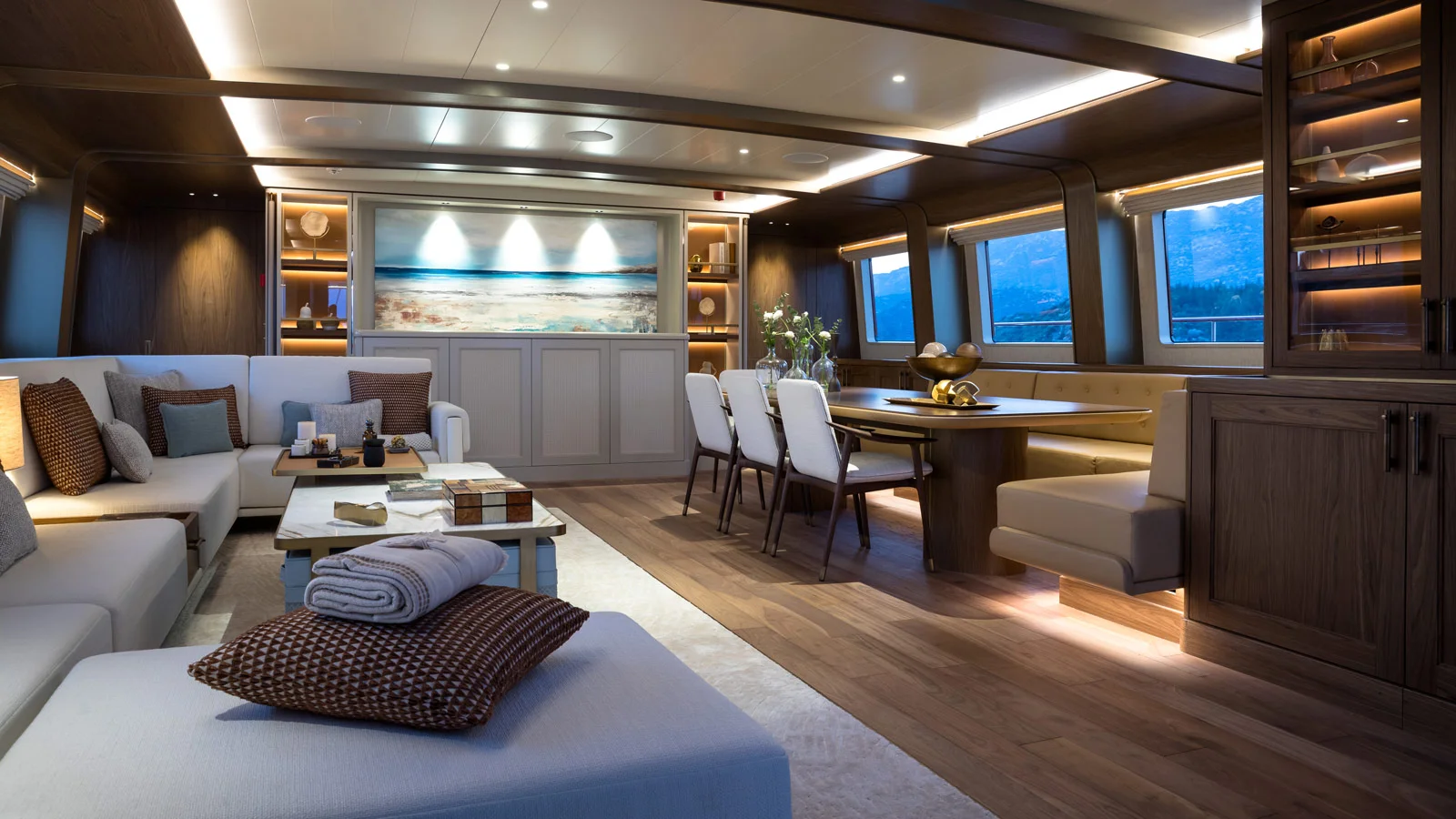
Two massive doors lead form the cockpit to the main saloon, which is a warm, almost club space with light upholstery and sleek oak furniture, large sofas, modern storage spaces in the form of lockers and chests. There are brass details like trays and coffee tables. The saloon is flooded with sunlight.
Access to the lower deck is particularly convenient if you come by tender and step onto the six-metre fold-down platform on the starboard side, then go down the steps to the wide hall that leads to different cabins.
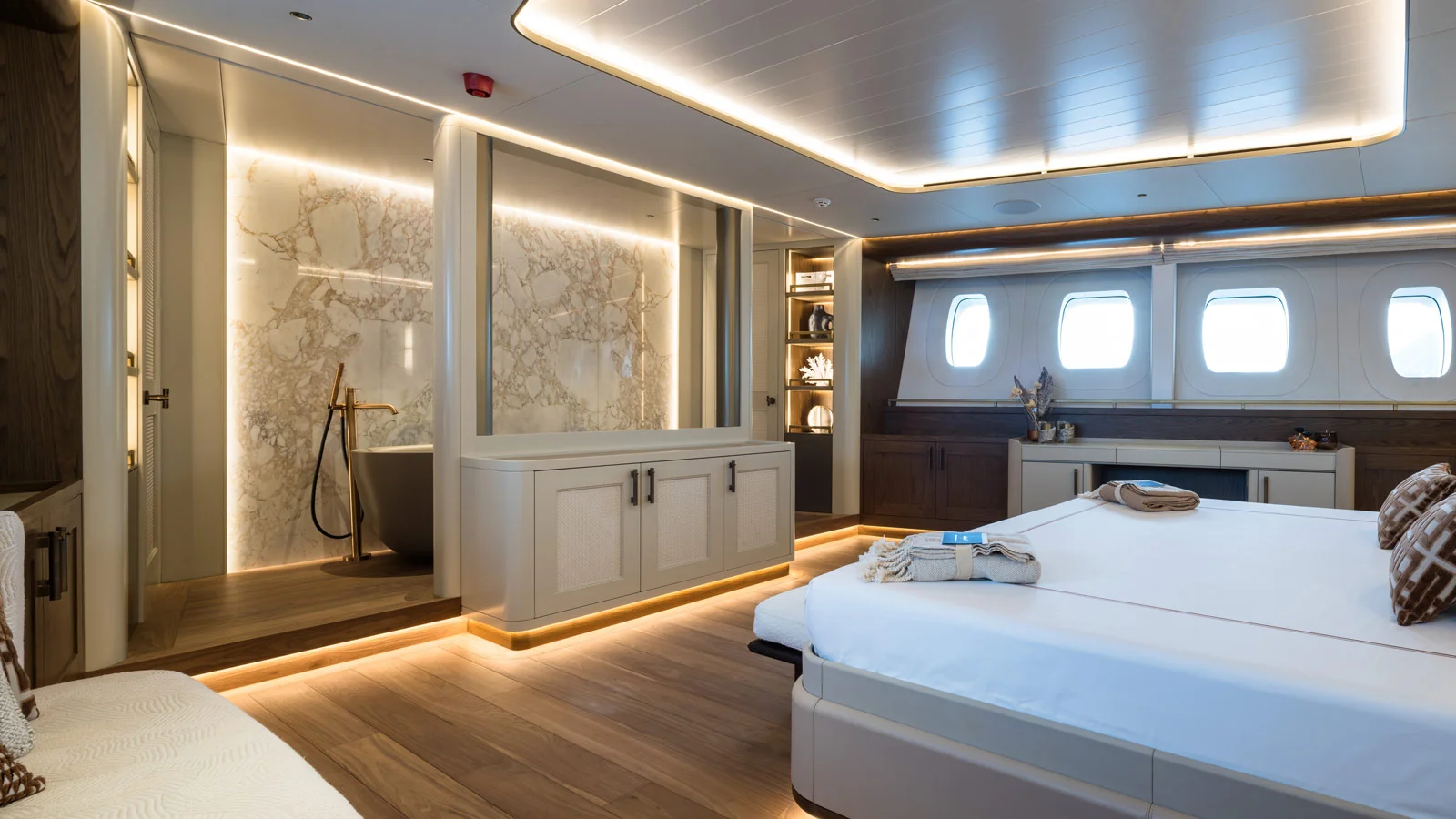
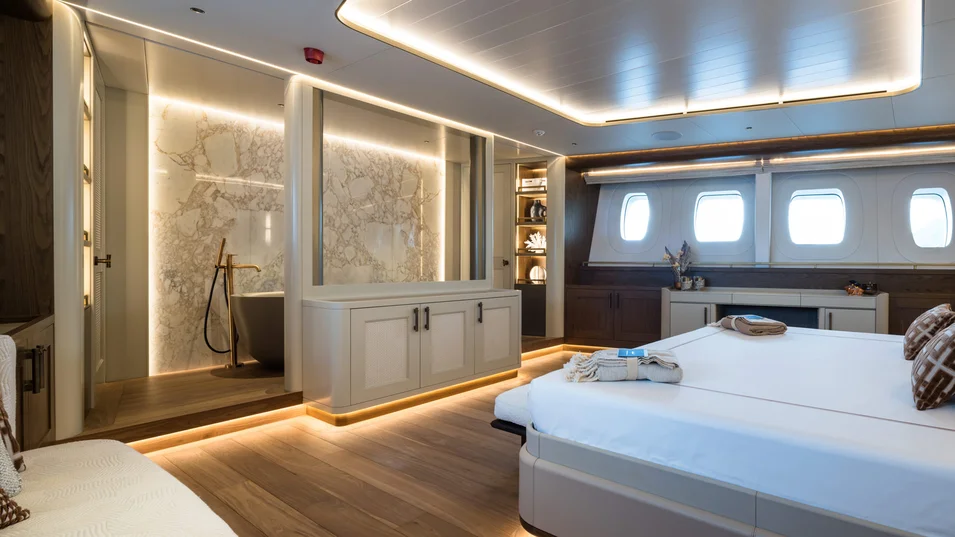
The master suite is located below deck forward. One can get there via a private corridor that can be closed off from the rest of the guest areas. There is a king-sized bed, a lounge area, a large desk that can transform into a vanity and a bathroom behind a transparent wall. The walk-in wardrobe and the bathroom are gran and spacious, which you don’t normally expect on board a sailing yacht. The area is comparable to a full-fledged suite on board a motor yacht.
Marrying traditional yachting values with contemporary technology and design, SIMENA’s interior styling aims to create a relaxed and refined sanctuary fit for escapism and the entertaining of family and friends when required.
John Everett, associate designer at Design Unlimited
The Simena features three more double cabins and two twins, which makes six cabins in total. Turkish marble of grey and lavender, as well as brass details, contrast beautifully with the black and brass finish of the fittings from Gessi.
The crew can also enjoy plenty of space: a captain’s cabin and three double cabins aft, alongside a large professional galley, a dining area and a laundry room. It is worth remembering that this sailing yacht was designed for long periods away from port.
The Simena is full of surprises, and she features a modern, hugely flexible hybrid propulsion system with six different modes, based on three diesel generators of 86kW each, a MAN engine 882 hp and a 220 kW electric motor. Under sail, her propeller can generate renewable electricity that covers the yacht’s systems. The electric motor allows her to cruise silently at a speed of up to 8 knots. In the hybrid mode the range is over 6,000 nautical miles at a speed of 7 knots. One MAN engine can deliver a speed of 14 knots, and at a speed of 11 knots she can cover up to 4,000 nautical miles, that is cross the Atlantic.
Comparing the environmental footprint of a sailboat and a motor yacht is a thankless task, given the vast differences in conditions and traditions. However, within the sailing sector itself, the question of what happens while at anchor or during a calm is becoming increasingly pressing. The Simena with her hybrid propulsion gives a clear answer to that question: silent electric propulsion at anchor, regenerative charging underway and no diesel generators running while sailing. The yacht was designed to remain compliant with strict regulations on both sides of the Atlantic, even ten years from now.
You have successfully subscribed to our newsletter